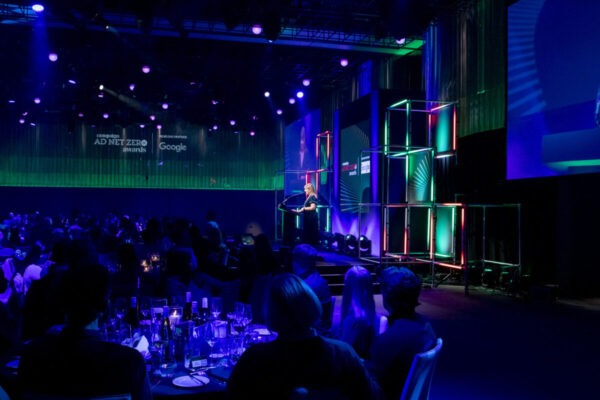
The 2025 IPA Sustainability Summit took place at a crucial inflection point for the advertising industry. As climate risks escalate, regulation tightens, client expectations shift, and young talent increasingly demands meaningful action, the Summit brought together industry leaders to explore how advertising can accelerate the transition to a net-zero economy.
Across the agenda, the speakers addressed moving from talking about sustainability to hard-wiring it into the commercial, operational, and creative backbone of the industry.
These are no longer fringe trends; they are market signals. And for advertising, they represent growth categories, new client types, new creative territories, and new responsibilities.
Tom also cited the expansion of the Campaign Ad Net Zero Awards – up 26% YoY!- as evidence that the industry is beginning to turn ambition into measurable change.
Leo Rayman, Founder and CEO, Eden Lab challenged the industry head-on with the provocation ‘Is the word “sustainability” holding us back?’
He urged agencies to redesign behaviour, aspiration, brands and growth by imagining the world we actually want to live in, then working backwards.
His example: envisioning a 2039 business – a laundrette to be specific- and mapping business models, consumer expectations, and value creation back from that future world.
He went on to ask which agencies were already working with the plethora of net-zero-aligned start-ups who are designing the future.
Leo’s case study of PEOPLE OWNED POWER demonstrated how community-owned energy can be narrated not through jargon, but through empowerment, autonomy, and identity. Advertising’s job is to amplify these new models with commercial rigour.
Jeremy Mathieu, Head of Sustainability, ITV and Pauline Robson, Sustainability, Consulting and Insight Leader discussed embedding climate strategy across an organisation the size and complexity of ITV.
Jeremy was clear- talking in scopes 1–3 doesn’t engage creative, commercial, or production teams.
Instead, ITV frames its work through three lenses:
This reframing has helped unify previously fragmented measurement and risk systems into a coherent organisational strategy.
Importantly, Jeremy described sustainability teams as “orchestrators of change”; teams that can’t make changes directly themselves, but can equip every team to act. That requires fluency not just in carbon accounting but in risk management, P&Ls, and organisational psychology.
Nature as the Next Competitive Frontier
Georgina Bramall, Marketing Strategy Director, giffgaff and Tim Pritchard, Executive Director, Head of Responsible Media, MG OMD showcased nature restoration as a brand and media opportunity. They backed this up with not one, but four perspectives, which were-
- A CITIZEN DESIRE- UK adults are twice as likely to support protecting land and sea compared to a net-zero pledge by 2050.
- EMPLOYEE RELATIONS- 70% of UK employees likely to encourage their employer to take action to help nature.
- A BUSINESS IMPERATIVE- Businesses are soon to be required to report on their environmental and biodiversity impacts e.g. TNFD.
- A BRAND OPPORTUNITY- Over three in five UK adults agree they are more likely to recommend a company that protects nature close.
You might be disappointed to know that only 8% of UK land and sea is currently protected across the UK, dropping to 2.6% in England when excluding Scotland, which is why MG OMD’s Up to Good Fund is such an important offering to the industry.
An open-sourced tri-partite “levy” model, the fund channels a percentage of media spend directly into verified nature restoration, and it has already avoided 2,869 tonnes CO₂e!
Their CTA to the industry- If just 0.1% of UK media spend were allocated this way by 2030, it could raise £200 million for nature.
It was great to see Ad Net Zero’s work with giffgaff across various pillars of their sustainable marketing-
- Through sustainable media planning with the GMSF
Florencia Lujani, Co-Founder, ACT Climate Labs and Laura Ranzato, Director of Community, Clean Creatives delivered a pivotal session offering both strategy and operational playbooks for agencies considering a managed exit from fossil-fuel linked work. Two core outputs anchored their talk:
- Clean Creatives – The Offramp Report: a practical framework to help agencies assess and transition away from fossil-fuel clients responsibly, balancing commercial risk and ethical responsibility.
- ACT Climate Labs – The Five Levers for Change: a blueprint of actionable strategies for agencies to re-shape portfolios and client pipelines toward climate-aligned business.
They identified three high-opportunity client and sector verticals for agencies to grow into: Healthcare, Renewables, and Circular Economy businesses — all areas aligned with long-term demand and lower climate transition risk.
Laura highlighted that the Most visited Meta page is Facebook marketplace points towards shifting consumer behaviour- whether led by price or sustainable dispositions- as both ethical and commercial opportunity, and emphasised the need for agency portfolios to reflect these trends.
They closed with a call to action- participate in the SBTi Corporate Net-Zero Standard V2 public consultation. This draft includes stronger expectations for target-setting, encouraging firms to adopt revenue phase-out targets for services linked to fossil fuel activities or to develop plans that grow net-zero-aligned services to 100% by 2050. (C18.5, p. 17 in the new draft).
The Clean Energy Super Power Mission
M&C Saatchi shared a preview of a UK Government campaign for the Department for Energy Security and Net Zero (DESNZ) which used humour and charm to convert consumers to the warm and fuzzy feeling brought on by having a heat pump in your home.
The “Feel All Warm and Fuzzy Inside” campaign spotlighted real homeowners’ experiences through the warmest, fuzziest medium possible; charming stop-motion animation.
Setting up the context of public attitudes and perception of the new technology by referencing findings from and before playing the joyfully executed campaign video which brought their response to life gave a holistic understanding to how the industry can help support the much needed adoption of low-carbon technologies in everyday life.
The Ad Net Zero Young Leaders: A Turning Point for the Industry
One of the Summit’s most consequential sessions came from the Ad Net Zero Young Leaders, presenting their work over the last year which has been built from insights courtesy of the IPA & Ipsos ‘Climate Anxiety’ research, with further research from KPMG and Credos, including-
- 1 in 3 young adults has rejected a job offer based on an employer’s ESG record (KPMG).
- Advertising employees are twice as likely as the general public to feel demoralised about climate change.
- 53% of agency staff feel anxious about the climate crisis — vs 37% of the wider public.
- 25–34-year-olds are 4× more likely than over-65s to believe advertising materially contributes to climate change (Credos 2024).
Their 4 recommendations to the industry are:
- Make sustainability part of everyday conversations.
- Introduce sustainability in metrics and appraisals.
- Adopt reverse mentoring – younger staff educating senior leaders.
- Make climate literacy a standard skill for all disciplines.
The Young Leaders will be launching these recommendations industry-wide soon, marking a key milestone in the movement’s evolution.
Campaign Ad Net Zero Awards 2025: Redefining Creative Excellence
The Summit concluded with a deep dive into two standout winners from the 2025 Campaign Ad Net Zero Awards – shining a light on the operational, creative, and cultural changes required to produce genuinely low-carbon, high-impact work.
VCCP: A focus on the way we work
James Johnstone showcased VCCP’s creative- and extensive!- work for TfL, and the in-depth rigour behind it all, which won them the ‘Best Practice in Sustainable Ad Production (UK)’ category at this year’s Campaign Ad Net Zero Awards.
Notably, their production-carbon matrix, mapping a full year of shoots to identify opportunities, failures, and patterns, was incredibly impressive, and helped support incredible results, including the fact they hit TfL’s 60% production-emission-reduction target five years early.
Born Social: A focus on the work we make
Will Menko demonstrated how Born Social’s work on Ford’s EV campaign, which won them the ‘Automotive, Travel & Transport’ category at this year’s Campaign Ad Net Zero Awards, succeeded by being social-first, talent-led, relatable, and focused on normalising everyday low-carbon behaviour.
As their presentation noted, we can shift behaviours if we actually communicate them (let’s boost above the current rate of 5.3% of ads showing sustainable behaviours!) and “make sustainability irresistible”.
For Ad Net Zero supporters, these award-winning approaches show that:
- climate-aligned work can be creatively outstanding;
- sustainability can spark innovation;
- and rigorous measurement can accelerate progress.
Together, they point to what futureproof creative excellence looks like.